The Benefits of Plyometric Training for Endurance Athletes
Most serious endurance runners appreciate and understand that endurance running is governed by maximal oxygen uptake and running economy (how much energy your body requires to sustain certain speeds). But what few people realise is that running economy can be developed through using plyometric training methods.
It might come as a surprise to many endurance athletes that ways to improve endurance go beyond running more miles and building strength in the gym. Numerous experts have extolled the benefits of investing in a well-considered programme of plyometrics. But what are plyometrics and are they for everyone?
Plyometrics consist of exercises that use rapid stretching, followed by forceful shortening of the muscles. This process is known as the stretch–shortening cycle. Movements such as jumping, hopping and skipping train the muscle–tendon unit to store and release elastic energy. This energy can be used to improve the speed and efficiency of force production. These adaptations, in endurance runners, enable athletes to move more efficiently and ultimately, this improves athletic performance.
To understand this better, let’s take two cars. Both cars are moving at the same speed, but one of the cars is not tuned correctly and is using more fuel because the engine isn’t functioning properly. The car that works more efficiently will use less fuel than the car with the defective engine. And in this way, we need our bodies to be functioning efficiently and moving economically.
Better running economy means you can run at the same speed and use less energy, or run faster before fatigue sets in. Multiple researchers have consistently concluded that well-designed plyometric training can improve running form and subsequently use energy more efficiently. Yet surprisingly, few endurance runners include it in their training. In fact, a body of research revealed that only 14 – 47% of runners use plyometrics as part of their training (Wynne, 2026).
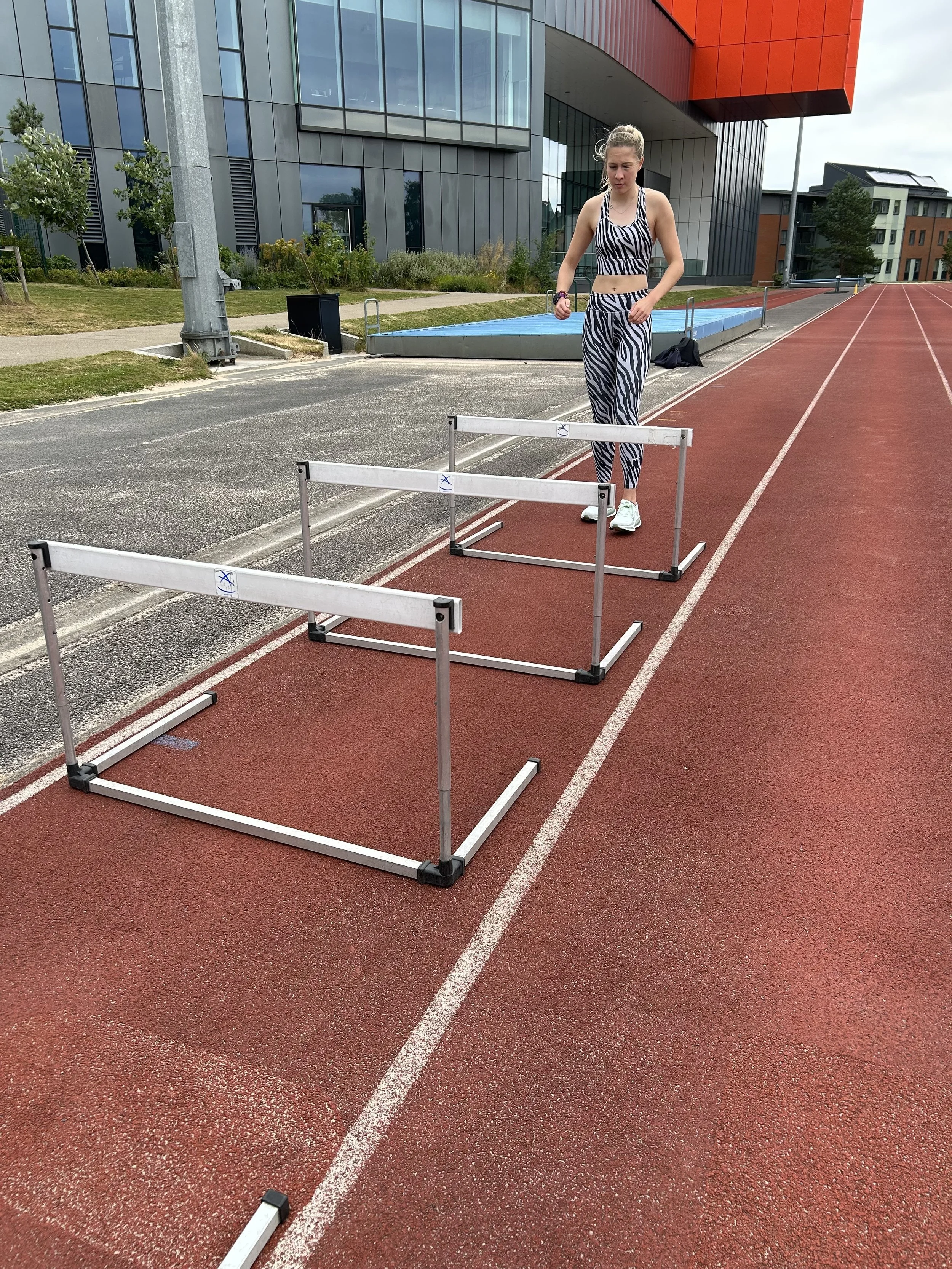
However, before you whip out your mini-hurdles and your plyo boxes, it is important to recognise that plyometric training is not a magic bullet that will get you hitting your PBs in 6 weeks. The rapid-stretch-shortening-cycle has been proven to develop elastic and neuromuscular contributions to movements, but athletes require a basic level of strength before embarking on a plyometric programme.
Running itself is a plyometric activity that relies upon a rapid eccentric lengthening of the muscle-tendon section of the leg. The movement phase creates an explosive concentric shortening that generates power. Each time the foot makes contact with the ground there is a rapid load and the release of the foot, ankle and calf. And what many people don’t realise is the load bearing force that is created. Each time the foot makes contact with the ground, the leg has to withstand 2 – 3 times the amount of body weight. Therefore, it should come as no surprise that runners are often blighted by injury.
The right application of plyometrics should never be disregarded. For an athlete’s form to be efficient there needs to a good elastic energy return. Imagine your tendons are tiny elastic bands. Each time your foot strikes the ground, they stretch and store elastic energy. The motion is similar to pulling back a slingshot or catapult. A millisecond later and that stored energy is released, propelling you into your next stride. The more efficiently your body can recycle this free energy, the less work your muscles have to do.
And it’s not just the elites that benefit from incorporating a plyometric programme into their routine. In recreationally trained runners, building stronger more reactive muscles reduces energy cost. Even skipping can help runners to improve foot-arch stiffness and reactive strength. Ten weeks of skipping enabled amateur runners to significantly improve their PBs (Garcia-Pinillos et al, 2020). Conversely, another recent trial concluded that ten weeks of strength training did not improve running economy and, in fact, this contributed to the deterioration of economy across a 90-minute run (Zanini et al, 2025). Therefore, whilst the gym may have its appeal and address some areas of weakness, it seems balancing strength training against plyometrics is something that all endurance athletes should consider.
Therefore, in returning to the analogy of the car, elite Formula 1 teams invest millions chasing miniscule improvements in efficiency. Teams painstakingly refine aerodynamics, reduce friction and recover lost energy. The search is for the small gains. And this is where plyometrics can help. Rather than making endurance athletes stronger or fitter, plyometrics improve the body’s ability to utilise energy. This results in a more efficient runner who wastes less energy. Small gains can make a significant difference over longer distances.
Like with any new programme of activity, readiness is an important factor. Experts recommend a movement screening and capacity check (Wynne, 2026). Runners without strength training are advised against completing a block of training before indulging in a robust programme of plyometrics. It’s not about scrolling through Instagram and discovering random influencers. A good foundation requires a systematic review to provide clear instruction on the movement required and meticulous planning on how to execute a programme without risk of injury.
Research convincingly highlights that plyometric training improves running economy in coached runners, but strength training is arguably the best-supported activity to limit running related injuries. However, poorly executed plyometrics can heighten the risk of injuries or contribute to a poorly developed running form. And in an age of influencers, where everyone seems to be an expert, this is a genuine cause for concern.
If you’re genuinely looking to improve your form, forgo Instagram or TikTok and engage the help of genuine, qualified experts. The take-home message, derived from extensive studies, is to enlist a physio and liaise with your coach (Bishop et al, 2026). Request a 6 – 12-week training block around a fixed set of exercises. A good coach will know what to look for in each movement; mastery is a priority. And as for most things in life, consistency is key.
Therefore, the science is clear when it comes to endurance running, it's not just about putting in the miles, it's about putting that spring in your step. But adaptations take time and, in running, one size doesn’t fit all.
Bibliography
Bishop, C., Chavda, S., & Turner, A. (2026). The role of strength and conditioning in supporting athletic performance, mitigating injury risk, and enhancing health: a narrative opinion. Strength and Conditioning Journal (online ahead of print).
Garcia-Pinillos, F., Lago-Fuentes, C., Latorre-Roman, P. A., Pantoja-Vallejo, A., & Ramirez-Campillo, R. (2020). Jump-rope training: improved 3-km time-trial performance in endurance runners via enhanced lower-limb reactivity and foot-arch stiffness. International Journal of Sports Physiology and Performance, 15(7), 927-933.
Wynne, K. (2026). Understanding and prescribing plyometrics for endurance runners: a review. Strength and Conditioning Journal (online ahead of print).
Zanini, M., Folland, J. P., Wu, H., & Blagrove, R. C. (2025). Strength training improves running economy durability and fatigued high-intensity performance in well-trained male runners: a randomized controlled trial. Medicine & Science in Sports & Exercise.